
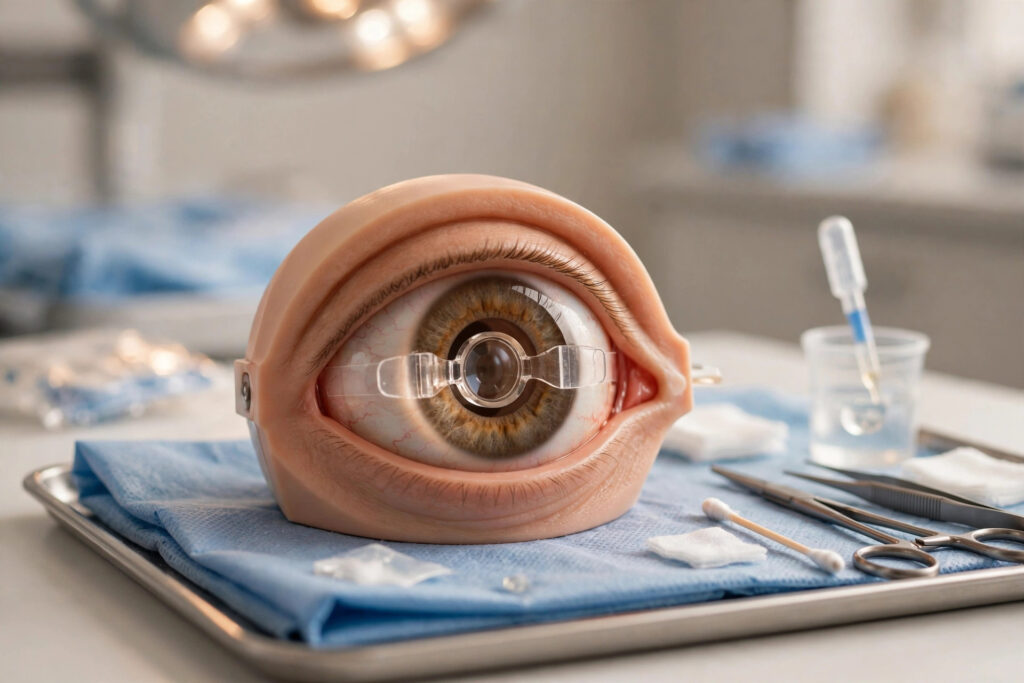
RLE vs LASIK is one of the most common comparisons in vision correction, because the two procedures solve similar problems in fundamentally different ways. LASIK reshapes the cornea with a laser to refocus light; refractive lens exchange, or RLE, removes the eye’s natural lens and replaces it with an artificial intraocular lens. Both can free suitable patients from glasses and contacts, but they differ in candidacy, risks, recovery, cost, and what they do about aging eyes. Choosing between them is less about which is “better” and more about which matches your eyes and your stage of life.
This article compares RLE and LASIK across every dimension that matters: the core technical difference, who qualifies for each, how vision outcomes compare, how the risks differ, what recovery looks like, and what each costs. It is general information to prepare you for a proper consultation, not a recommendation. Only a qualified refractive eye surgeon who has examined your eyes can advise which option, if either, is appropriate for you.
Table of Contents
- The Core Difference: Cornea vs Lens
- Candidacy: Who Qualifies for Each
- Vision Outcomes Compared
- Risks Compared Honestly
- Recovery and Downtime
- Cost Comparison
- Making the Decision with Your Surgeon
The Core Difference: Cornea vs Lens
LASIK works on the cornea, the eye’s clear front window. A femtosecond laser creates a thin hinged flap, an excimer laser sculpts the underlying tissue to correct the prescription, and the flap is repositioned. The natural lens inside the eye is untouched, which means the eye keeps its youthful focusing ability but also keeps aging normally: presbyopia and cataracts remain future events. LASIK is a surface-level reshaping with decades of outcome data behind it.
RLE works inside the eye. Through a tiny incision, the surgeon removes the natural crystalline lens and implants a foldable artificial lens chosen for the patient’s prescription and visual goals. It is essentially cataract surgery performed electively before a cataract exists. Because the aging lens is gone, presbyopia is addressed at its source with appropriate lens designs, and a cataract can never develop afterward.
This anatomical distinction drives almost every other difference. LASIK preserves the natural lens and its remaining focusing power, making it ideal for younger patients; RLE sacrifices the natural lens, which only makes sense once that lens has become more of a problem than an asset, typically from the mid-40s onward. Understanding this framing makes the rest of the comparison fall into place.
Candidacy: Who Qualifies for Each
LASIK candidacy centers on the cornea: adequate thickness, a regular shape, a stable prescription, and healthy tear function. Ideal LASIK patients are generally between their early 20s and early 40s with mild to moderate nearsightedness, farsightedness, or astigmatism. Disqualifiers include thin or irregular corneas, very high prescriptions beyond the safe ablation range, significant dry eye, and unstable vision. A detailed OD vs OS on Your Prescription Explained“>eye exam with corneal mapping is the gatekeeper.
RLE candidacy centers on the lens and the retina: patients typically over 45 whose prescriptions are too high for safe LASIK, whose corneas are unsuitable, or who have presbyopia or early lens changes driving their visual complaints. Because the procedure enters the eye, retinal health must be excellent; high myopes need careful retinal screening since they carry a higher baseline detachment risk. Uncontrolled glaucoma or certain corneal diseases can rule RLE out.
Age is the simplest heuristic, though never the whole story. Under 40 with a normal lens, LASIK or another corneal or phakic-lens procedure is almost always the discussion; over 50 with presbyopia and a changing prescription, RLE enters the conversation seriously. The decade in between is genuinely individualized, which is why reputable surgeons evaluate rather than assume.
Vision Outcomes Compared
For suitable candidates, both procedures deliver excellent distance vision, and most patients achieve strong uncorrected acuity. LASIK’s outcomes are superb for distance correction in younger eyes, but it does nothing for presbyopia: a 48-year-old with perfect LASIK distance vision will still need reading glasses, because the aging lens is untouched. This is the single most common source of disappointment when older patients choose LASIK without understanding the limitation.
RLE with premium lenses can address distance, intermediate, and near vision together, offering a glasses-independence that LASIK cannot match after presbyopia arrives. Multifocal and extended-depth-of-focus implants are designed exactly for this. The trade-off is optical: multifocal designs can reduce contrast slightly and cause halos around lights at night, effects that LASIK patients rarely experience. Monofocal RLE lenses keep optics clean but leave reading glasses in the picture, much like LASIK does.
Patient satisfaction is high for both when candidacy is right and expectations are set honestly. The National Eye Institute’s resources on refractive errors provide useful background on how each approach corrects vision. The wrong procedure for the wrong eye, however, satisfies nobody, which returns us to candidacy as the deciding factor.
Risks Compared Honestly
LASIK’s risks live mostly on the cornea: dry eye, flap complications, glare and halos, and rare corneal weakening. Dry eye is the most common significant side effect, usually temporary but occasionally persistent, and it is the main reason thorough pre-operative tear film evaluation matters. Serious vision-threatening complications from LASIK are uncommon in properly screened patients, and the procedure’s multi-decade track record is reassuring.
RLE’s risks live inside the eye: infection, inflammation, pressure spikes, retinal detachment, and swelling of the central retina. These are the standard risks of intraocular surgery, shared with cataract surgery, and while uncommon, they are more serious in character than LASIK’s typical complications. Posterior capsule clouding months or years later is common but easily fixed with an in-office laser. The risk profiles are genuinely different in kind, not just degree.
Neither list should frighten a suitable candidate away from a procedure they need, and neither should be minimized. A candid surgeon discusses the specific risks for your eyes, in plain language, before you decide. Be wary of any consultation that presents either procedure as risk-free.
Recovery and Downtime
LASIK recovery is famously fast: functional vision within hours, most patients back at desk work the next day, with dryness and light sensitivity fading over days to weeks. The flap needs protection from rubbing in the early period, but there is no incision into the eye and no shield routine beyond the first nights. For busy younger patients, this minimal downtime is a major attraction.
RLE recovery is also quick but slightly more involved: each eye is done separately, vision is functional within a day or two, and a drop regimen with nighttime shielding continues for the first weeks. Between the two surgeries there is a bridging period of temporary imbalance. Full adaptation to a premium lens’s optics, particularly multifocal designs, can take weeks to months as the brain learns the new visual system.
In practical terms, both procedures fit into normal life with modest planning. LASIK edges ahead on pure speed and simplicity; RLE asks a little more patience in exchange for solving presbyopia and preempting cataracts. Neither requires extended time off for typical office work.
Cost Comparison
RLE generally costs substantially more than LASIK, often roughly double per eye at the same practice, reflecting the operating suite, the premium implant, and intraocular surgical expertise. LASIK pricing in 2026 at reputable clinics commonly sits in the low-to-mid thousands per eye, while RLE with premium lenses runs several thousand per eye. Both are elective and typically paid out of pocket, with financing plans widely available.
The lifetime-value framing differs by age. A 28-year-old comparing LASIK against decades of Contact Lens Hygiene Mistakes to Avoid“>contact lenses and How to Stop Glasses Slipping Down Your Nose“>eyeglasses may find the math compelling; a 60-year-old comparing RLE against LASIK plus inevitable future cataract surgery may find RLE the more economical long view. These calculations are reasonable context, but candidacy and safety must lead the decision, not the spreadsheet.
One cost trap to avoid: choosing LASIK at 50 to save money, then needing cataract surgery at 65 anyway, is not necessarily a bad outcome, since both procedures did their jobs in sequence. The mistake is choosing without understanding that sequence in advance.
Making the Decision with Your Surgeon
The decision framework is simpler than the marketing suggests. If you are under 40 with a stable prescription and healthy corneas, LASIK or a related corneal or lens-implant procedure is usually the conversation. If you are over 50 with presbyopia, a high prescription, or early lens changes, RLE deserves serious consideration. Between those poles, the right answer depends on measurements only an examination provides.
Come to the consultation with questions: which procedure does the surgeon recommend for your specific eyes and why, what are the alternatives they considered and rejected, what lens or laser profile would they use, and what does their enhancement and complication policy cover? A surgeon who offers only one of the two procedures may still give good advice, but a practice offering both can compare without bias.
Take time, get a second opinion for a decision of this magnitude, and choose based on your eyes rather than on price or novelty. The American Academy of Ophthalmology’s treatment overviews are a solid neutral starting point before any consultation. The best procedure is the one matched carefully to you.