
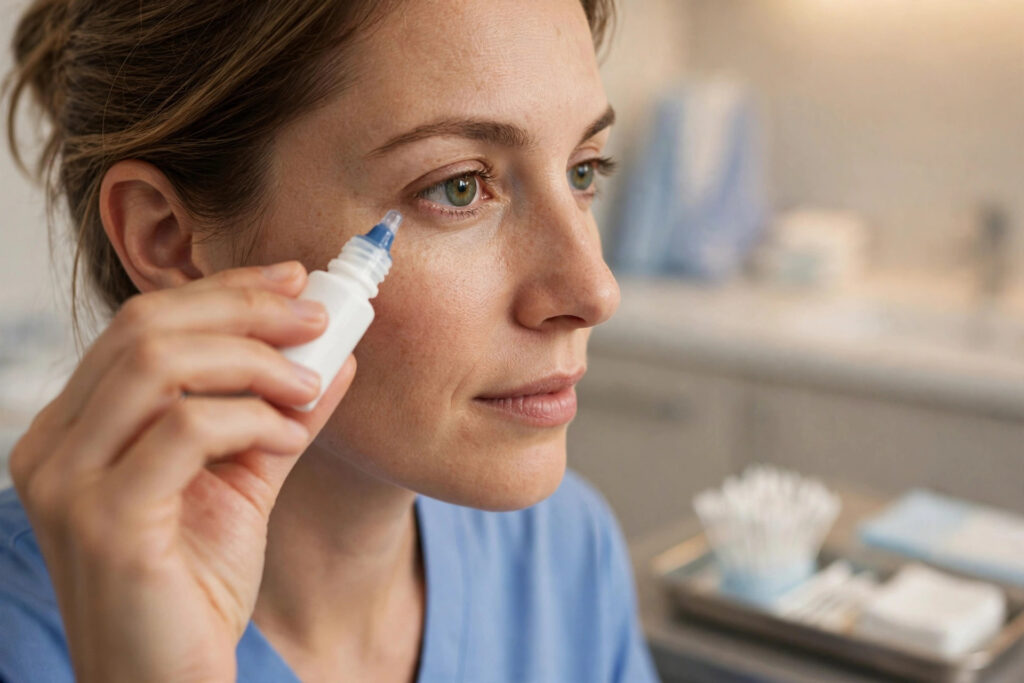
Dry eye is the single most common side effect of LASIK, and the one patients ask about most. Almost everyone experiences some dryness in the weeks after surgery; for most it fades, for some it lingers, and for a small minority it becomes a long-term condition needing ongoing care. Understanding why LASIK causes dryness, who is most vulnerable, and how it is managed turns an anxious unknown into a plannable part of the process.
This article explains the biology behind post-LASIK dry eye, the risk factors surgeons screen for, the typical timeline, and the full range of treatments available in 2026. It is general information, not medical advice. If you are considering LASIK, discuss your personal dry eye risk with a qualified refractive eye surgeon as part of your evaluation.
Table of Contents
- Why LASIK Causes Dry Eye
- Who Is Most at Risk
- The Typical Timeline of Recovery
- What Happens Before Surgery
- Managing Dryness After Surgery
- When Dryness Persists
- Key Questions to Ask Your Surgeon
Why LASIK Causes Dry Eye
The cornea is one of the most densely innervated tissues in the body, and those nerves do more than sense pain: they form part of the feedback loop that tells the eyes to produce tears. Creating the LASIK flap severs many of these nerves across a wide circular zone. With the signaling disrupted, tear production drops and the blink reflex becomes less responsive, so the tear film breaks up faster between blinks.
The good news is that corneal nerves regenerate. Over weeks to months, nerve fibers grow back into the treated area and tear function typically recovers toward its pre-operative baseline. The bad news is that regeneration is gradual and incomplete in some patients, which is why dryness peaks early and then improves on a slow curve rather than vanishing overnight. Flapless procedures like SMILE cut fewer nerves and generally show faster tear film recovery, one of their documented advantages.
There is also a secondary mechanism worth knowing about. An irregular healing corneal surface can destabilize the tear film mechanically, and post-operative medications, particularly preserved drops used over long periods, can irritate the ocular surface. Surgeons account for all of this in the aftercare plan, which is why the drop regimen matters and should be followed exactly as prescribed.
Who Is Most at Risk
The strongest predictor of post-LASIK dry eye trouble is pre-existing dry eye. Patients who already experience gritty, tired, or burning eyes, who struggle with What to Do If a Contact Lens Tears in Your Eye“>contact lenses because of dryness, or who use artificial tears regularly are starting from a deficit. LASIK does not reset the tear system to normal; it temporarily worsens whatever baseline exists. This is the main reason tear film testing is a non-negotiable part of screening.
Several other factors raise risk. Women, particularly around hormonal transitions, report dry eye more often. People who spend long hours on screens blink less and evaporate more tears. Dry, air-conditioned, or windy environments aggravate symptoms. Certain medications, including some antihistamines, antidepressants, and acne treatments, reduce tear production. Autoimmune conditions such as Sjogren’s syndrome are red flags that surgeons take very seriously.
Age plays a role as well, since tear production naturally declines over the decades. None of these factors alone is an automatic disqualification, but together they build a risk profile. A careful surgeon will tally them honestly and may recommend treating dryness aggressively before surgery, choosing a different procedure, or in some cases advising against laser correction entirely.
The Typical Timeline of Recovery
For the average patient, the dry eye story after LASIK follows a predictable arc. The first days to weeks bring the most noticeable dryness, managed with frequent preservative-free artificial tears. Over the first one to three months, symptoms typically improve steadily as nerves regenerate and the surface smooths. By six months, most patients feel essentially back to their baseline, and objective tear measurements have largely normalized.
That “most patients” framing matters. Healing curves vary, and some people take closer to a year to feel fully normal. Fluctuating vision during the day, worse in the afternoon or evening, is a classic dry-eye pattern and usually not a sign that the laser correction itself is failing. Keeping a simple symptom diary can help your surgeon distinguish normal healing dryness from something needing intervention.
What should prompt an earlier call to the clinic: dryness that is worsening rather than improving after the first month, significant pain, or vision that is getting blurrier instead of sharper. These are not typical healing patterns and deserve prompt evaluation. Routine follow-up visits are scheduled partly to catch exactly these deviations, so attend every one.
What Happens Before Surgery
Modern dry eye screening goes well beyond asking whether your eyes feel dry. Clinics measure tear breakup time, assess the oil-producing meibomian glands along the eyelids, and may use imaging to grade the tear film’s quality. Patients with significant findings are usually asked to complete a course of pre-treatment before any surgery date is set.
Pre-treatment has become increasingly sophisticated. Warm compresses and lid hygiene address meibomian gland dysfunction, the leading cause of evaporative dry eye. Prescription anti-inflammatory drops can calm ocular surface inflammation. In some practices, in-office procedures that clear blocked glands are offered before surgery. The American Academy of Ophthalmology’s dry eye overview describes the condition and its standard treatments in patient-friendly terms.
This pre-operative phase is also when expectations are set. A surgeon who finds borderline dryness should tell you plainly that your recovery may involve more drops for longer, and that your outcome depends partly on how the ocular surface responds. That conversation, however unwelcome, is far better than discovering it afterward.
Managing Dryness After Surgery
The foundation of post-operative dry eye management is preservative-free artificial tears, used frequently in the early weeks. Preservative-free matters: the preservatives in bottled drops can irritate a healing cornea with repeated use. Your surgeon will specify a tapering schedule; follow it rather than improvising, but also do not hesitate to use extra drops when your eyes feel dry, since comfort and healing go together.
Beyond drops, simple habits make a real difference. Consciously blinking fully during screen work, using a humidifier in dry rooms, avoiding direct air vents and fans on the face, and wearing wraparound How to Tell If Sunglasses Have UV Protection“>sunglasses outdoors to block wind all reduce tear evaporation. These sound trivial, but patients who adopt them consistently report noticeably easier recoveries.
For moderate cases, surgeons add prescription options: anti-inflammatory drops that increase natural tear production, short courses of mild steroids to calm inflammation, or punctal plugs, tiny devices placed in the tear drainage ducts to keep tears on the eye longer. These are routine tools, not signs of failure, and most patients who need them use them temporarily.
When Dryness Persists
A minority of patients find that dryness has not resolved by the six-to-twelve-month mark. Persistent post-LASIK dry eye is frustrating, but it is also a recognized condition with an established treatment ladder. Advanced options include autologous serum drops made from the patient’s own blood, scleral contact lenses that vault over the cornea and bathe it in fluid, and in-office gland treatments. Management is usually handled collaboratively between the refractive surgeon and a dry eye specialist.
It is important to keep perspective: persistent significant dry eye after LASIK is uncommon in well-screened patients, and severe, life-altering cases are rare. But “rare” is cold comfort if you are the one affected, so the emphasis belongs on prevention through screening. Patients with significant pre-existing dryness who are counseled toward a flapless procedure, aggressive pre-treatment, or no surgery at all are being protected, not rejected.
If you are already experiencing prolonged dryness after LASIK, do not simply accept it or self-treat indefinitely with over-the-counter drops. Return to your surgeon or seek a dry eye specialist for a structured evaluation. The field has more tools than ever, and most persistent cases can be substantially improved with the right plan.
Key Questions to Ask Your Surgeon
Go into your LASIK evaluation ready to discuss dry eye directly. Ask how your tear film tested and what the numbers mean. Ask whether you need pre-treatment and how long it should take. Ask what the drop regimen will be after surgery and what happens if dryness persists beyond the expected timeline. And ask honestly whether your personal risk profile suggests a flapless alternative or a non-surgical path.
Also ask about the clinic’s approach to patients who develop persistent dryness: is there a dry eye specialist on the team or a referral pathway? A clinic that has thought this through is a clinic that takes the risk seriously. The National Eye Institute’s dry eye resource is a solid neutral reference to read before the appointment.
Finally, keep up with regular Contact Lens Fitting Exam Explained“>eye exams after LASIK, dry eye or not. Laser correction changes the cornea but does not exempt you from the routine monitoring every adult eye needs. Dry eye after LASIK is common, usually temporary, and highly manageable when surgeon and patient address it as a team from the very first screening visit.