
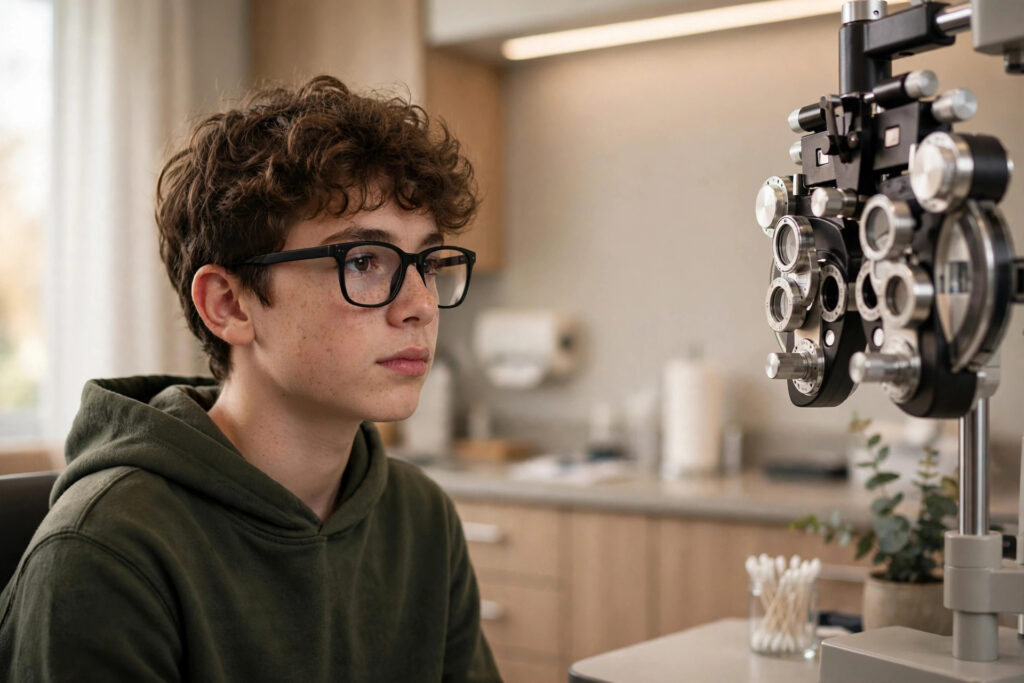
LASIK is one of the most popular elective procedures in the world, so it is natural for teenagers who are tired of glasses or contact lenses to ask whether they can have it too. Many teens dealing with sports, school, and social life see LASIK as a quick route to freedom from eyewear. The short answer, though, is that laser vision correction is almost never performed on patients under 18, and for good medical reasons.
This article explains the age rules that govern LASIK, why a stable prescription matters more than a birthday, what regulatory approvals actually say, and what vision correction options are realistic for teenagers in 2026. It is general information only, not medical advice. Any decision about a teenager’s eyes should be made with a qualified refractive eye surgeon and the teen’s regular eye doctor.
Table of Contents
- Why Teenagers Ask About LASIK
- The Age Rule, Explained
- Why Prescription Stability Matters More Than Age
- FDA Approval and Legal Requirements
- Vision Correction Alternatives for Teenagers
- What Teens Can Do While They Wait
Why Teenagers Ask About LASIK
For teenagers, the appeal of LASIK is easy to understand. Glasses can feel like a burden during sports, where frames slip, fog, or risk breaking. Contact lenses help but require daily discipline with cleaning and wear schedules that not every teen maintains consistently. Socially, many teens simply prefer how they look without glasses, and the idea of a one-time procedure that fixes vision permanently is understandably attractive.
Online content sometimes adds to the pressure. Influencers and clinics occasionally describe LASIK as quick, painless, and life-changing, which can make it sound like a routine option for anyone with a prescription. What gets less attention is that these success stories come from carefully screened adults. A teenager’s eyes are still changing, and performing laser correction on an eye that is still growing can produce results that do not last, or in rare cases complicate future treatment.
Parents often find themselves caught in the middle: wanting to say yes to something that would genuinely make their teen’s life easier, but unsure whether it is safe. Understanding the real medical reasoning behind the age rules helps the whole family have a calm, informed conversation instead of one driven by marketing or wishful thinking.
The Age Rule, Explained
Most reputable refractive surgeons set 18 as the absolute minimum age for LASIK, and many prefer to wait until 21 or later. This is not an arbitrary cutoff. The teenage years are a period of active eye growth: the eyeball can continue lengthening into the late teens and even early twenties, and every millimeter of change shifts the prescription. Correcting vision with a laser while the eye is still changing is like tailoring a suit for someone who is still growing.
There is also a legal dimension. LASIK is elective surgery, and patients under 18 cannot legally consent to it themselves in most jurisdictions. A parent’s signature does not override the medical contraindication: a surgeon who operates on an unstable teenage eye would be acting against established professional standards. Any clinic that offers LASIK to a minor without serious reservations should be treated with skepticism.
Rare exceptions exist, but they are medical exceptions, not elective ones. In unusual cases, such as a child with an extreme prescription difference between the two eyes that cannot be corrected any other way, surgeons sometimes consider laser procedures. These are highly specialized situations decided by pediatric ophthalmologists, not something a family requests for convenience. For the overwhelming majority of teenagers, the answer is to wait.
Why Prescription Stability Matters More Than Age
Age 18 is a guideline; prescription stability is the actual requirement. Surgeons typically want to see that a patient’s glasses or contact lens prescription has not changed significantly for at least one to two years before considering LASIK. Some clinics want an even longer stable window. The reason is straightforward: LASIK reshapes the cornea to match your current prescription, and if the prescription keeps drifting, the correction becomes outdated.
Nearsightedness in particular tends to progress through the teenage years and often settles in the early to mid-twenties. A teen whose prescription has worsened every year is a poor candidate, even if they have technically turned 18. Conversely, a 19-year-old whose prescription has been rock-steady for three years may be a reasonable candidate. The eye exam history, not the birth certificate, is what the surgeon weighs most heavily.
This is also why teens should keep attending regular eye exams even while waiting. A documented history of stable prescriptions over several visits is exactly what a surgeon will want to review later. Skipping exams in the teenage years means arriving at a LASIK consultation with no usable stability record, which delays the process further.
FDA Approval and Legal Requirements
In the United States, the lasers used for LASIK are approved by the FDA for patients 18 and older, and the clinical studies behind those approvals enrolled adults. Using the technology on younger patients would be off-label use, which carries additional legal and ethical weight for the surgeon. The FDA’s LASIK information page outlines the risks patients should understand and the questions to ask any prospective surgeon.
Other countries follow similar professional standards even where the exact regulations differ. Ophthalmology societies worldwide advise against laser vision correction in patients whose eyes are still developing. This is a rare point of broad international consensus in refractive surgery: the waiting period is protective, not paternalistic.
Families should also be aware that no reputable surgeon will be persuaded by persistence. If a clinic agrees to operate on a 16-year-old after being asked firmly enough, that is a red flag about the clinic, not a green light about the procedure. Ethical practices turn away underage patients routinely and explain why.
Vision Correction Alternatives for Teenagers
Waiting for LASIK does not mean suffering through the teenage years with vision that does not work for an active life. Modern How to Clean Eyeglasses Without Scratching Them“>eyeglasses are lighter, tougher, and more stylish than ever, and sports-specific frames with straps handle most athletic needs. For teens who dislike the look of glasses, today’s frames are arguably a fashion item rather than a burden.
Contact lenses are the closest thing to the freedom LASIK promises, and many teens do very well with them. Daily disposable lenses in particular have simplified lens care dramatically: no cleaning solutions, no cases, just a fresh sterile pair each morning. An eye doctor can assess whether a teen is responsible enough for lens wear, and most are by their mid-teens. Advances in Contact Lens Prescription vs Glasses Prescription“>contact lens materials have made them more comfortable and breathable than the lenses of a generation ago.
For teens with progressing nearsightedness, there is also a genuinely medical option worth discussing with an eye doctor: myopia control. Specialized contact lenses, low-dose atropine drops, and orthokeratology (overnight corneal reshaping lenses) can slow the progression of myopia during the growing years. These are managed by eye care professionals and are a far more appropriate intervention for a teenager than laser surgery.
What Teens Can Do While They Wait
The waiting years can be put to good use. Teens interested in eventual LASIK should protect their eyes now: wear quality sunglasses with full UV protection outdoors, take regular breaks from screens, spend time outdoors (which research associates with slower myopia progression in children), and never sleep in contact lenses unless specifically prescribed for it.
Keep every glasses and contact lens prescription on file, and attend eye exams on the schedule the eye doctor recommends. That paper trail of stability becomes the foundation of a future LASIK evaluation. Teens can also start learning about the procedure itself: the Best Glasses for Kids and Toddlers: 2026 Guide“>kids vision resources many practices publish explain how young eyes develop and why patience pays off.
Most importantly, teens should know that waiting is not missing out. The LASIK performed at 22 on a stable eye is the same technology, often improved, and the outcome is far more likely to be the lasting result they wanted in the first place. A few years of glasses or contacts is a small price for vision correction that actually endures. When the time comes, a qualified refractive surgeon will confirm candidacy with a full screening.