
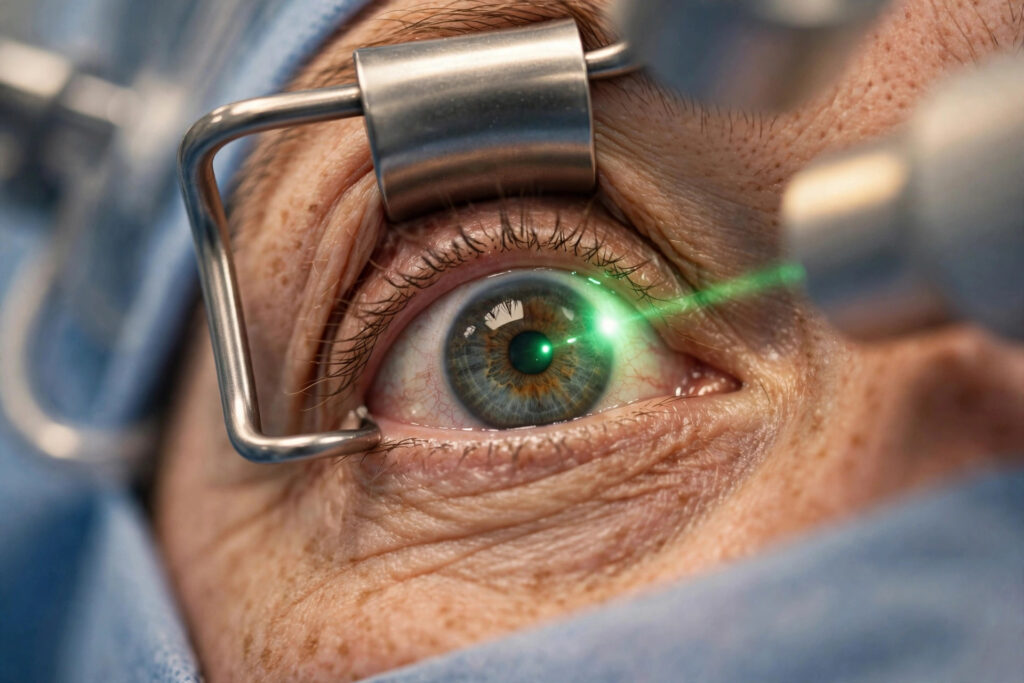
LASEK eye surgery, short for Laser-Assisted Sub-Epithelial Keratectomy, is a surface-based laser vision correction that sits somewhere between PRK and LASIK. Like PRK, it avoids creating a corneal flap. Unlike PRK, it preserves the thin outer epithelial layer and replaces it after the laser reshaping instead of discarding it. The result is a gentler surface procedure that some surgeons prefer for patients with thinner corneas or specific occupational needs.
LASEK never became as widely adopted as LASIK or PRK, and fewer clinics offer it in 2026, but it remains a legitimate option with its own logic. This article explains how LASEK works step by step, how it compares with its better-known cousins, what recovery feels like, who it suits, and what it typically costs. As with any elective eye surgery, use this as background for a thorough discussion with a qualified refractive eye surgeon, not as a substitute for one.
Table of Contents
- What LASEK Is
- How the Procedure Works Step by Step
- LASEK vs LASIK vs PRK
- Recovery Timeline
- Who LASEK Suits Best
- Cost and Final Thoughts
What LASEK Is
LASEK is a form of laser vision correction that reshapes the cornea to treat nearsightedness, farsightedness, and astigmatism, using the same excimer laser technology found in LASIK and PRK. Its distinguishing feature is how it handles the epithelium, the paper-thin layer of cells covering the corneal surface. Rather than removing this layer outright as in PRK, LASEK loosens it and folds it aside as a living sheet.
The loosening is done with a diluted alcohol solution applied to the corneal surface for a short period, typically well under a minute. This softens the bonds holding the epithelial sheet in place so the surgeon can gently move it aside, perform the laser reshaping on the exposed tissue beneath, and then reposition the sheet over the treated area. A bandage contact lens is placed on top to hold everything in place during early healing.
Because the epithelial sheet is preserved, many surgeons describe LASEK as a kinder variant of surface ablation. The repositioned epithelium acts as a natural biological bandage over the treated area, which in theory supports healing. In practice, the visual outcomes are comparable to PRK, and the choice between the two often comes down to surgeon training and preference rather than a decisive evidence-based advantage.
How the Procedure Works Step by Step
The procedure begins the same way as other laser corrections: numbing drops, a reclined treatment chair, and positioning under the excimer laser. Once the eye is numb, the surgeon places a small well-like instrument on the cornea and fills it with a weak alcohol solution for a brief period to loosen the epithelium. The solution is then rinsed away thoroughly.
Next, the surgeon gently folds the loosened epithelial sheet aside, exposing the stromal tissue underneath. The excimer laser then reshapes the cornea according to the patient’s prescription, a step that usually takes less than a minute for moderate corrections. Patients typically see lights and hear the laser’s clicking but feel no pain thanks to the anesthetic drops.
After the ablation, the epithelial sheet is carefully smoothed back into position over the treated zone, and a bandage contact lens is placed on the eye. Antibiotic and anti-inflammatory drops are started immediately. The entire procedure takes only a few minutes per eye, and both eyes are commonly treated in one session.
LASEK vs LASIK vs PRK
Against LASIK, LASEK’s main distinction is the absence of a flap. There is no flap to dislodge, wrinkle, or develop ingrowth, which makes LASEK attractive for patients whose work or sports carry eye-injury risk. The trade-off, shared with PRK, is a slower and less comfortable recovery than LASIK’s famously quick bounce-back.
Against PRK, the difference is subtler. Both are surface ablations with similar healing timelines and final visual results. LASEK’s preserved epithelial sheet may reduce discomfort slightly and could lower the risk of corneal haze, though the evidence is mixed and many surgeons consider the two essentially equivalent. PRK is far more widely offered, which matters when choosing an experienced provider.
One practical consideration is availability. Because LASEK occupies a middle ground without a decisive advantage over PRK, many refractive practices standardized on LASIK plus PRK and stopped offering LASEK. If you are specifically interested in it, you may need to seek out a surgeon who performs it regularly, since familiarity with the technique affects outcomes in surface procedures.
Recovery Timeline
Recovery after LASEK closely mirrors PRK. The first three to five days are the healing window: the bandage contact lens stays in place, vision is blurry, and patients commonly experience grittiness, watering, and light sensitivity. Prescribed drops and oral pain relief as directed make this period manageable for most people, and resting in a darkened room helps.
The bandage lens is typically removed at a follow-up visit once the surface has healed over. Vision then improves noticeably over the following one to two weeks, though fluctuations are normal as the cornea settles. Many patients return to desk work within a week, while activities like swimming, eye makeup, and dusty environments are off-limits for the period the surgeon specifies.
Full visual stabilization generally takes a few months, similar to PRK. Lubricating drops are used frequently during healing, and follow-up visits let the surgeon confirm the surface is healing cleanly. Long-term results in suitable candidates are comparable to other laser procedures, with a large majority achieving excellent uncorrected vision. Patients who rely on How Long Can You Wear Monthly Contact Lenses?“>contact lenses should note that lens wear must stop for a period before surgery so the cornea returns to its natural shape for accurate measurements.
Who LASEK Suits Best
LASEK candidacy follows the same principles as PRK. It suits adults with stable prescriptions and healthy eyes whose corneas are too thin for a safe LASIK flap but still thick enough for surface ablation. People in contact sports, emergency services, or military roles sometimes choose it specifically for the flapless safety profile.
A thorough pre-operative workup is essential and should include corneal thickness and topography mapping, tear film assessment, and a dilated retinal examination. A detailed Color Vision Test (Ishihara): How It Works“>eye exam of this kind is what separates a safe candidate from a risky one, regardless of which surface procedure is chosen.
LASEK is not appropriate for everyone. Significant corneal irregularity, keratoconus, uncontrolled dry eye, corneal scarring in the treatment zone, and unstable prescriptions are disqualifying factors, as they are for PRK. Pregnancy and nursing are reasons to wait. Anyone considering LASEK should also confirm the surgeon performs the procedure regularly rather than occasionally, since surface techniques reward practiced hands.
Cost and Final Thoughts
LASEK is generally priced in the same range as PRK at clinics that offer it, which at many practices means slightly less than contemporary LASIK. As always, compare complete packages: screening, surgery, medications, all follow-up visits, and the enhancement policy. A lower headline price that excludes follow-up care can end up costing more.
Is LASEK worth seeking out over PRK? For most patients the honest answer is that the differences are modest, and the surgeon’s skill with their preferred surface technique matters more than the choice between LASEK and PRK. Where LASEK earns its place is as a flapless alternative to LASIK with a slightly gentler healing concept than PRK, offered by surgeons who believe in it.
If you are weighing surface ablation, ask prospective surgeons which technique they perform most often and why, what their enhancement rates look like, and how they manage post-operative haze risk. Advances in How Progressive Lenses Work: Complete Guide“>lens technology also mean modern glasses and contacts remain excellent alternatives for anyone who decides surgery is not for them. The American Academy of Ophthalmology’s LASEK overview offers a concise second source before your consultation.