
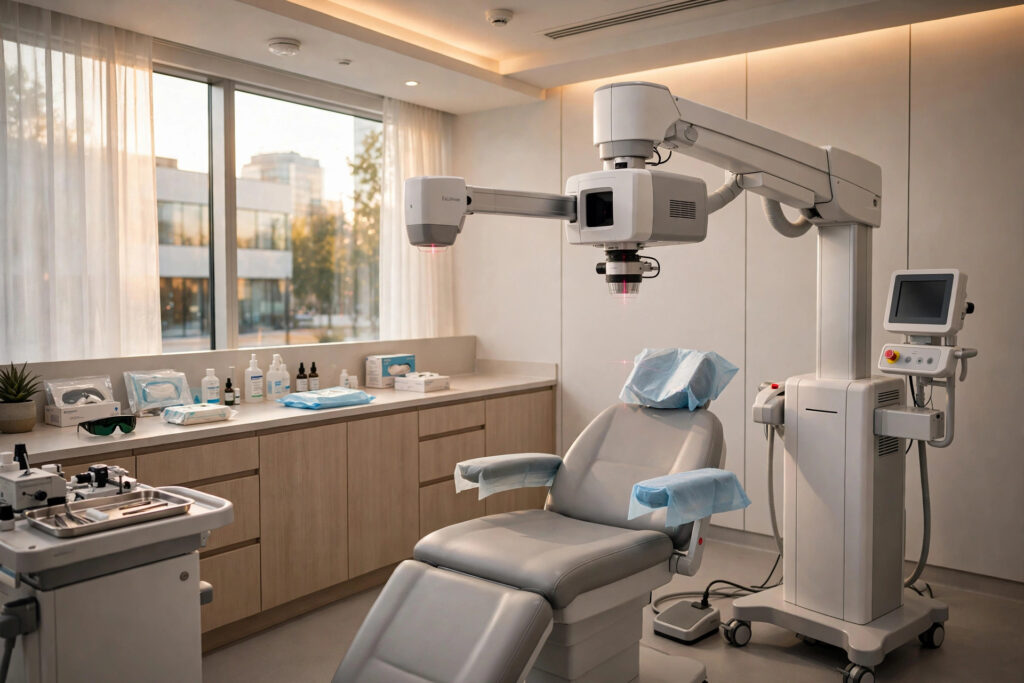
PRK and LASIK are the two most widely performed forms of laser vision correction in the world. Both reshape the cornea with an excimer laser to correct nearsightedness, farsightedness, and astigmatism, and both have decades of clinical experience behind them. If you are researching laser eye surgery in 2026, these are almost certainly the two names you will encounter first.
The essential difference between them is how the surgeon reaches the corneal tissue that needs reshaping. LASIK creates a thin, hinged flap in the cornea and performs the reshaping underneath it. PRK skips the flap entirely and works directly on the corneal surface after the thin outer epithelial layer is removed. That single difference shapes recovery time, candidacy rules, and risk profiles, which is why surgeons recommend one over the other for different eyes. This guide compares PRK vs LASIK across every dimension that matters so you can discuss your options intelligently with a qualified refractive eye surgeon.
Table of Contents
- How PRK and LASIK Differ
- What Happens on Procedure Day
- Recovery Compared
- Vision Results and Risk Profiles
- Who Is a Better Candidate for Each
- Cost and How to Decide in 2026
How PRK and LASIK Differ
In LASIK, the surgeon uses a femtosecond laser to create a thin, hinged flap in the cornea, folds it back, and then applies the excimer laser to reshape the exposed stromal tissue beneath. The flap is then repositioned, where it adheres naturally without stitches. The whole process is highly automated, and the flap creation step takes only seconds per eye.
PRK takes a flapless approach. The surgeon gently removes the cornea’s thin outer epithelial layer, either with an instrument, a diluted alcohol solution, or in newer trans-PRK variants, with the laser itself. The excimer laser then reshapes the exposed corneal surface directly. Afterward, a bandage contact lens is placed on the eye to protect it while the epithelium regrows over the following days.
Despite the different access routes, the actual vision-correcting step is very similar: both procedures use the excimer laser to sculpt the cornea so light focuses correctly on the retina, and both can use advanced wavefront or topography-guided profiles to customize the treatment. The meaningful distinctions show up in healing, not in the laser physics.
What Happens on Procedure Day
Both procedures are performed as outpatient surgery with numbing eye drops, so you remain awake but comfortable, and no general anesthesia is needed. Each eye typically takes only a few minutes, and both eyes are usually treated in the same session. You will need someone to drive you home afterward.
During LASIK you may feel brief pressure when the suction ring holds the eye steady for flap creation, followed by the reshaping laser, which many patients describe as painless. PRK feels similar during the laser phase, though there is no suction pressure from flap creation. Neither procedure is typically painful while it is happening.
The immediate aftermath differs noticeably. LASIK patients often see reasonably well within hours and are surprised by how quickly vision returns. PRK patients leave with blurry vision and a bandage contact lens in place, since the surface needs time to heal before clear vision emerges. Clinics give both groups protective eyewear and detailed drop schedules before discharge.
Recovery Compared
LASIK recovery is famously fast. Most patients achieve functional vision within hours, return to desk work the next day, and notice steady improvement over the first week. Dryness, light sensitivity, and mild halos around lights at night are common early on and usually fade over weeks to months as the corneal nerves recover.
PRK recovery asks for more patience. The epithelial layer regrows over roughly three to five days beneath the bandage contact lens, and during that window patients commonly experience discomfort, watering, and light sensitivity that is more pronounced than after LASIK. Vision fluctuates during the first week and continues sharpening gradually, with full stabilization often taking a few months rather than weeks.
Longer healing does not mean a worse final result. Once fully healed, visual outcomes after PRK are broadly comparable to LASIK for equivalent prescriptions. The trade-off is simply time and temporary discomfort in exchange for a flapless cornea, which is exactly why some patients and surgeons prefer it.
Vision Results and Risk Profiles
In terms of final vision, both procedures perform very well in properly screened candidates. A large majority of patients achieve 20/20 or better uncorrected vision with either technique, and patient satisfaction rates are high for both. The choice between them is rarely about which gives sharper vision and almost always about anatomy, lifestyle, and healing preferences.
LASIK’s risks center on the flap. Flap dislocation from trauma, flap wrinkles, and epithelial ingrowth beneath the flap are uncommon with modern femtosecond flaps but remain unique to LASIK. Dry eye also tends to be more noticeable in the early months after LASIK because flap creation severs more corneal nerves than surface ablation does.
PRK avoids flap complications by definition, but it carries its own considerations. The healing surface can develop corneal haze, a scarring response that modern surgeons largely control with medications such as mitomycin-C applied during surgery. Infection risk is slightly higher during the days the epithelium is regrowing, and the extended steroid drop course requires careful follow-up. The FDA’s overview of laser vision correction procedures describes both techniques and their safety profiles in neutral terms.
Who Is a Better Candidate for Each
LASIK requires enough corneal thickness to safely create a flap and still leave adequate tissue beneath for the ablation. Patients with thin corneas, irregular corneal maps, or certain surface conditions may not qualify. A comprehensive pre-operative Color Vision Test (Ishihara): How It Works“>eye exam with corneal topography and thickness mapping is what determines eligibility, not the prescription alone.
PRK is often the recommendation when LASIK is not advisable. Because no flap is created, it preserves more tissue and is suitable for thinner corneas that still meet safety thresholds. Surgeons also tend to recommend PRK for people in contact sports, military service, or occupations with a meaningful risk of eye trauma, since there is no flap that could ever be dislodged.
Both procedures share the same general requirements: adults with stable prescriptions, healthy eyes free of significant disease, and realistic expectations. Pregnancy, nursing, uncontrolled dry eye, keratoconus, and autoimmune healing disorders are reasons to wait or to rule out laser surgery altogether. A candid surgeon will sometimes recommend PRK for one eye and LASIK for the other, or neither procedure, based purely on the measurements.
Cost and How to Decide in 2026
At many clinics PRK and LASIK are priced similarly, though PRK is sometimes slightly less expensive since it uses less laser time and no flap-creation step. What matters more than the headline price is what is bundled in: the screening workup, the surgery itself, all follow-up visits, medications, and the enhancement policy if a touch-up is ever needed. Compare complete packages, not isolated quotes.
A practical decision framework looks like this. If your corneas qualify for both, you value the fastest possible return to normal life, and you accept a small flap-related risk profile, LASIK is the natural fit. If your corneas are on the thinner side, you play contact sports, or you simply prefer a flapless cornea and can tolerate a slower recovery, PRK is the stronger choice. Many patients find the surgeon’s measurements make the decision for them.
Whatever you choose, take time with the decision, verify the surgeon’s experience with the specific procedure, and be skeptical of prices far below the local norm. And remember that excellent Sports Glasses and Goggles: Complete Guide“>eyeglasses remain a superb non-surgical option, while quality Are Expensive Sunglasses Worth It?“>sunglasses with full UV protection are wise for every post-operative eye. The American Academy of Ophthalmology’s PRK guide is a solid second opinion source before you commit.