
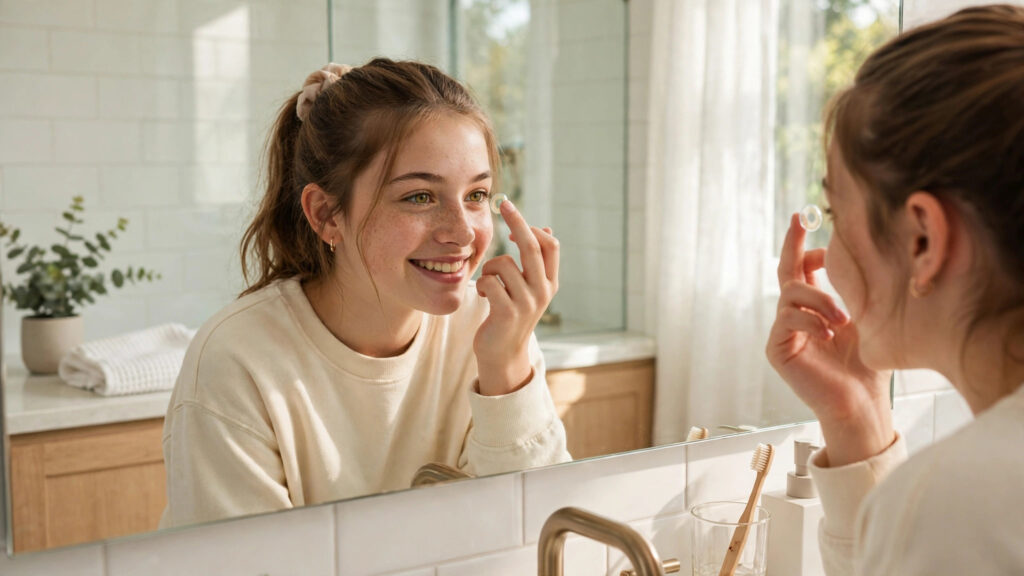
For many teenagers, switching from glasses to contact lenses is a rite of passage — driven by sports, appearance, or simply wanting a change. But teens are also the age group most likely to cut corners on lens hygiene, making the choice of lens type and the commitment to safe habits especially important.
This guide covers the best contact lens options for teenagers, how to tell if your teen is ready, safety essentials, and practical advice for parents navigating the transition.
Table of Contents
- Is Your Teen Ready?
- Best Lens Types for Teens
- Daily Disposables: The Top Pick
- Lenses for Sports and Active Teens
- Safety Rules That Matter Most
- Cost Considerations
- When Contacts Are Not the Answer
Is Your Teen Ready?
Readiness is about responsibility, not age. Good signs: your teen handles daily routines independently (homework, chores, hygiene), follows multi-step instructions, can tolerate touching their eyes, and wants contacts for their own reasons — not just peer pressure. Most eye doctors consider ages 11-14 a reasonable starting range, with maturity mattering more than the birthday.
Warning signs: chronic disorganization (losing things constantly), resistance to hygiene routines, or inability to follow the insertion/removal training during the fitting. There is no shame in waiting a year — glasses are excellent vision correction, and a teen who is not ready for lens responsibility is better served by stylish frames.
The fitting appointment itself is a readiness test: teens learn insertion and removal with the doctor, and those who cannot master it in the office need more time. A good fitter will be honest about readiness rather than pushing lenses.
Best Lens Types for Teens
Soft daily disposable lenses are the consensus best choice for most teenagers: a fresh sterile lens every morning, no cleaning or storage, minimal infection risk, and no compliance burden around solution and cases. For teens — the demographic most likely to skip cleaning steps — eliminating those steps eliminates the biggest risks.
Biweekly or monthly soft lenses cost less per lens but demand rigorous cleaning, case hygiene, and replacement-schedule discipline. Studies consistently show teens stretch replacement schedules and skimp on cleaning; if your family chooses reusables, parents should supervise the routine until it is genuinely habitual.
Specialty options exist for specific needs: toric lenses for astigmatism (now available in daily disposable from major brands), multifocal contacts for teens with focusing issues, and myopia-control lenses (MiSight) for teens whose nearsightedness is still progressing — worth discussing at the fitting exam.
Daily Disposables: The Top Pick
Daily disposables lead on every metric that matters for teens: safety (lowest infection rates of any soft lens modality), convenience (no solutions, no cases, no cleaning), and comfort (a fresh lens daily means no protein buildup). Popular options include Acuvue Oasys 1-Day, Dailies Total1, Biotrue ONEday, and MyDay — your fitter will trial the best match for your teen’s eyes.
The main drawback is cost: dailies run roughly 50-100% more than monthlies over a year. But factor in the eliminated solution costs and — more importantly — the reduced risk of a corneal infection that costs far more in treatment and missed school. Many parents find the premium worthwhile for peace of mind.
Dailies also simplify travel, sleepovers, and sports: teens can carry spare lenses without solution bottles, and there is no “I forgot to clean them” failure mode. For the forgetful-teen use case, this simplicity is a safety feature.
Lenses for Sports and Active Teens
Contacts are transformative for teen athletes: full peripheral vision (no frame edges), no fogging, no slipping during sweat, and compatibility with protective gear. For sports with eye-injury risk — basketball, baseball, racquet sports, soccer — pair contacts with sport-specific protective sports eyewear or goggles as appropriate.
Swimming requires special caution: never swim in contact lenses (or wear them in hot tubs) — water exposes lenses to Acanthamoeba and other microorganisms that cause severe, potentially blinding infections. Teens who swim should wear prescription swim goggles instead, removing contacts first.
For outdoor sports, UV-blocking contact lenses add a layer of protection but do not replace sunglasses — contacts cover only the cornea, leaving the surrounding eye and eyelid skin exposed. The combination of UV contacts plus sport sunglasses is the gold standard for outdoor athletes.
Safety Rules That Matter Most
Drill these non-negotiables: never sleep in lenses unless specifically prescribed for overnight wear; never use tap water on lenses or cases (Acanthamoeba lives in tap water); wash and dry hands before handling lenses; replace lenses on schedule — no stretching dailies to two days; and remove lenses immediately if eyes become red, painful, or light-sensitive.
Makeup and contacts: insert lenses before applying makeup, remove them before removing makeup, and replace eye makeup regularly to avoid contamination. Sharing lenses or solution — even with a best friend — is an infection vector; lenses are prescription medical devices, not accessories.
Parents should know the red flags requiring same-day care: significant pain, light sensitivity, discharge, or vision changes while wearing lenses. The FDA and American Academy of Ophthalmology both stress that most serious contact lens complications are preventable with proper hygiene.
Cost Considerations
Annual costs for teen contact lens wear typically range from $200-400 for monthlies (plus $100-150 in solutions) to $500-800+ for dailies, before exam and fitting fees ($100-250 for the fitting, plus the annual evaluation). Vision insurance often provides a contacts-or-glasses allowance that offsets these costs.
Budget honestly for the full picture: fitting fees, annual evaluations (required for prescription renewal), lenses, solutions (if applicable), and a backup pair of glasses — which every contact lens wearer needs for days when eyes need a break or lenses are unavailable.
Do not economize by buying lenses from unverified online sellers or stretching replacement schedules. Counterfeit lenses are a real problem, and overworn lenses are a leading cause of complications. Legitimate retailers verify prescriptions — a legal requirement that protects your teen.
When Contacts Are Not the Answer
Some teens are poor candidates: severe dry eye, frequent eye infections, significant allergies affecting the eyes, or prescriptions that cannot be adequately corrected with soft lenses. Very high astigmatism or irregular corneas may require rigid or scleral lenses — manageable but demanding more commitment.
Motivation matters too: a teen who wants contacts solely because friends have them, but dreads touching their eyes, will struggle. And teens with executive-function challenges may need more parental scaffolding around the routine — which is fine, as long as the scaffolding is actually provided.
Glasses remain an outstanding option — modern frames are stylish, safe, and zero-maintenance. The goal is the best vision correction for your teen’s life, not contacts at any cost. A candid conversation with your eye doctor about readiness, lifestyle, and eye health will point to the right choice.